
The Struggle with a Distorted Image
For as far back as I can remember, I carried a distorted image of God. I often felt like He wasn’t there and didn’t care about me. When I did give thought to Him, I imagined He was angry and disappointed, and I couldn’t face Him because of guilt and shame. My thoughts and actions were morally impure because my self-image was as corrupt as my image of God, which in turn distorted the way I viewed others.
Even after I accepted Christ into my life, I still wrestled with those same distorted images. I saw God as a moral judge who demanded something I could never live up to. Because I struggled with a poor self-image and a warped view of others, I chased after the wrong things, trying to fill the emptiness with what the world offered. The guilt and shame that followed were overwhelming. I was trapped in a sin–repent–sin-again cycle that seemed never-ending—and it was maddening.
A Turning Point with Tozer
Then one day, I read something by A. W. Tozer that struck a deep chord. He said, in essence, that we can’t expect our morals to stay sound or our hearts to stay right if our view of God is distorted. When we see Him wrongly, everything else in life starts to bend out of shape.[1] That single thought opened my eyes and sparked a deep study of who God reveals Himself to be through Scripture. It was the beginning of a journey that would lead me to rediscover what it means to live the God-shaped life.
Discovering God’s Love Anew
As I began reading, I found passages that completely transformed my image of God. In Ephesians I read, “But God, being rich in mercy, because of His great love with which He loved us” (Ephesians 2:4). Then came Jesus’ parable of the lost sheep (Matthew 18:12–14), a beautiful picture of a God who seeks and saves the one who has wandered off. And of course, there’s the verse so many of us know by heart—John 3:16: “For God so loved the world that He gave His one and only Son.”
I began to read the Bible in a new light and started to understand what Paul meant when he wrote about “the love of Christ that surpasses knowledge” (Ephesians 3:19)—a love so vast and unexplainable that it reaches into every corner of our hearts and changes the way we see everything. God’s love truly defies understanding.
As I began to view God’s love differently, my self-image started to change. If God loves me so much that He was willing to give His Son for me, then I must be valuable and have a purpose in His plan. As my image of God and my self-image were transformed, I began to see others differently too—through the lens of God’s love rather than as objects or means. That’s when I began to realize what it means to embrace the God-shaped life identity that He designed from the beginning.
The Path Toward Restoration
While reflecting on all this, I began to wonder where our distortions of God, self, and others begin. My study revealed that our perceptions are shaped by several spheres of influence—our genetics, parental or guardian figures, culture and media, and our religious experiences (or lack thereof). I also discovered that distorted images of God, self, and others deeply affect our mental, physical, spiritual, and emotional well-being, among other calamities that flow from seeing through a broken lens.
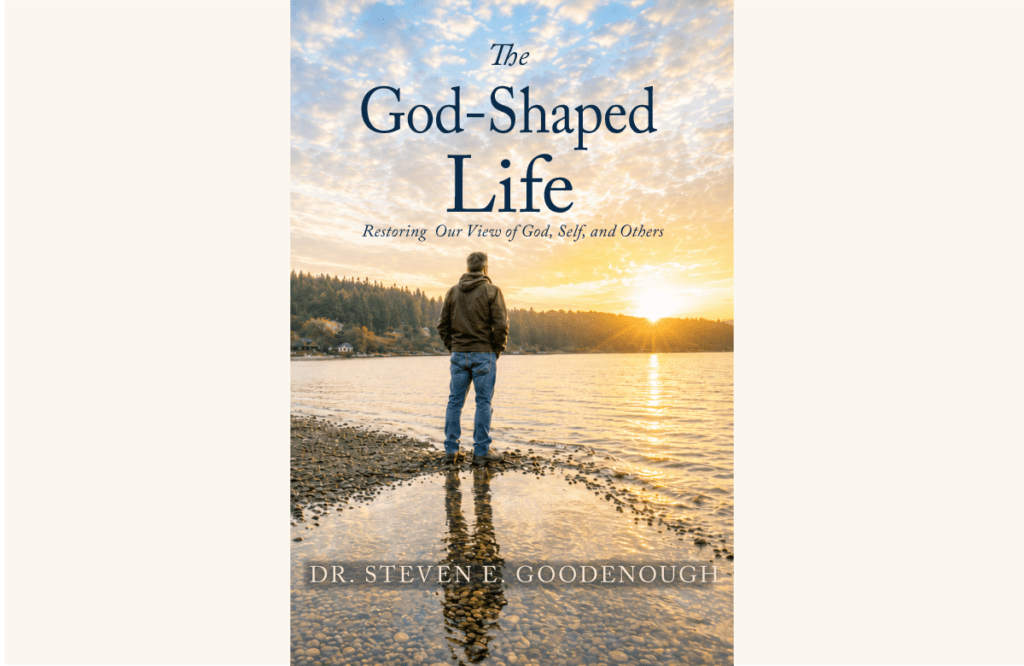
These insights, along with a practical path toward restoring our view of God, self, and others to align with His revelation in Scripture, are what The God-Shaped Life is all about. It’s about rediscovering who God really is, understanding who we are in Him, and learning to see others through His eyes of love.
[1] A. W. Tozer, The Knowledge of the Holy (New York: Harper & Row, 1961), 1.